
In the world of specialty chemicals, few dye classes have managed to balance brilliance, durability, and cost-effectiveness as successfully as Acid Metal Complex (AMC) dyes. Used across textiles, leather, inks, plastics, and high-end industrial coatings, these dyes are engineered to offer deeper shades, better fastness, and enhanced chemical stability—qualities that modern industries increasingly rely on.
As sustainability pressures rise and customers demand stronger performance from materials, AMC dyes are experiencing a renewed wave of innovation. From greener formulations to digitally-optimized dyeing systems, the sector is evolving rapidly, supported by both global chemical giants and an exciting group of emerging startups.
Explore the sample report and unlock the future of dye innovation
Click to learn more.
Acid Metal Complex dyes are a class of colorants formed through the coordination of dye molecules with metal ions—typically chromium, cobalt, or copper. This coordination significantly improves lightfastness, washfastness, solubility, and affinity to protein fibers such as wool, nylon, silk, and leather.
Their unique properties make them essential in:
What truly sets them apart is that they produce rich, uniform shades while requiring lower dye quantities—a win for both production cost and environmental impact.
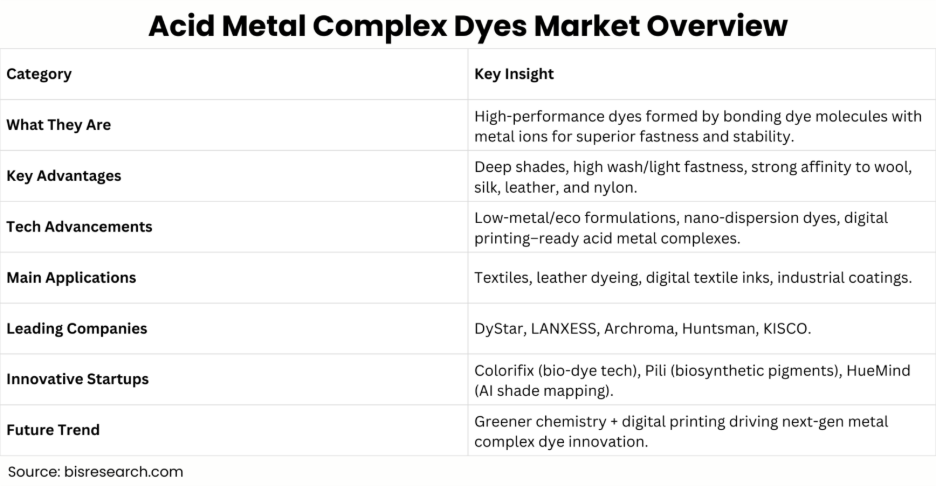
The AMC dye industry, once considered mature, is undergoing a surprising technological revival. Several factors are driving innovation:
1. Greener Complexation and Eco-Friendly Metal Alternatives
Traditional AMC dyes often use chromium complexes, which raise environmental concerns. New chemistry approaches focus on:
Companies are now engineering “next-gen” acid dyes designed to meet EU REACH restrictions, OEKO-TEX standards, and ZDHC requirements.
2. Digital Printing and Nanotechnology
Digital textile printing is booming, and AMC dyes are being reformulated for inkjet-grade particle sizes with better dispersion stability. Nanotechnology helps create:
This evolution directly benefits luxury fashion, sports textiles, home décor, and high-speed printing operations.
3. AI-Optimized Dyeing Systems
Smart dyeing platforms are integrating AMC dyes with:
These systems dramatically reduce water and energy consumption while ensuring shade consistency.
Ready to discuss your strategic needs?
Schedule a call with our experts today.
Global Chemical Leaders Driving R&D
Some of the biggest innovators in AMC dyes include:
These companies continue to innovate in low-impact dye formulations, digital printing compatibility, and global compliance.
Emerging Startups to Watch
The specialty dye space is also seeing the rise of technology-driven startups:
These startups are pushing the boundaries of how dyes are made, tested, and applied—often complementing rather than replacing AMC dyes.
The future of AMC dyes lies at the intersection of high performance and high sustainability. Expect to see:
While AMC dyes will remain a cornerstone for industries needing strong fastness and deep shades, they will increasingly be manufactured through cleaner chemistries and smarter technologies.
Looking to enter a new market but unsure where to start? At BIS Research, we provide first-hand insights directly from key opinion leaders (KOLs), backed by rigorous primary and secondary research.